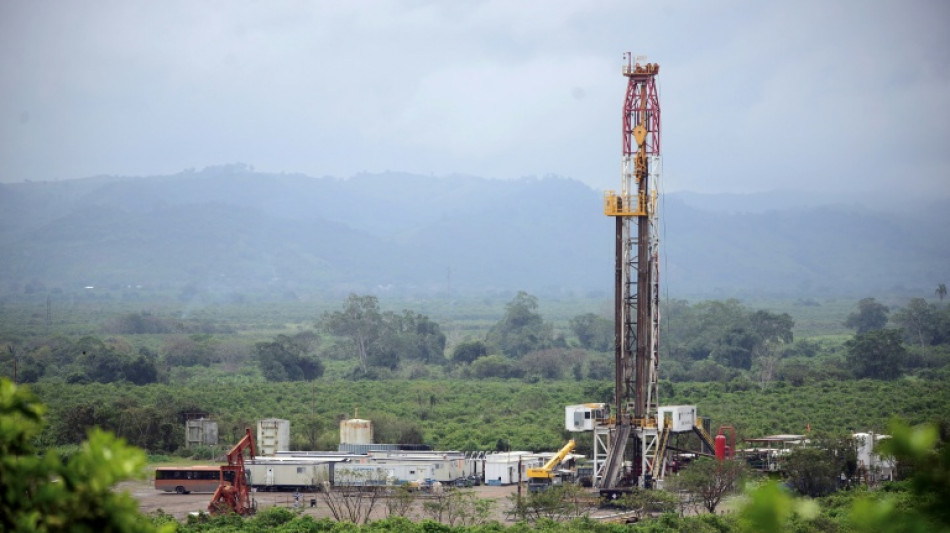
Mexican farmers raise alarm over Sheinbaum's fracking proposal / Photo: Marco Antonio MARTINEZ - AFP
Over the two decades since fracking started near their lands, farmers in the Mexican state of Veracruz have watched their orange and lime trees wilt away.
Now they're joining scientific experts to denounce Mexican President Claudia Sheinbaum's proposal to expand fracking.
The president presented experts in her Wednesday morning press conference who will analyze strategies for extracting natural gas through hydraulic fracturing.
The proposal is part of the left-leaning government's plan to reduce the country's outsized dependence on US fossil fuels, which represents up to 70 percent of oil consumed in Mexico.
Sheinbaum's plan represents a sharp turn from the policy of her predecessor and mentor, Andres Manuel Lopez Obrador (2018-2024), who roundly opposed the controversial practice.
Sheinbaum told journalists the plan to push fracking isn't final, and that it hinges on expert opinion and consulting communities where the project will be implemented.
"We're going to make the decision on the basis of scientific knowledge, not a decision from the president," she said.
Fracking entails extracting natural gas and petroleum from subterranean bedrock.
The process is criticized for using industrial quantities of water to break open rocks, as well as causing chemical contamination and provoking micro-earthquakes.
It's performed in already depleted oil or gas fields as well as unconventional basins as deep as 5,000 meters (16,400 feet) beneath the Earth's surface.
Mexico's government is following the path the United States paved over 15 years ago, when fracking helped transform it into the world's largest producer of petroleum and gas.
Until 2019, Mexico made limited hydraulic fracturing explorations in about 30 non-conventional wells.
However, it also had around 8,500 conventional wells which were extracted through the same means, Manuel Llano, a member of the NGO Mexican Alliance against Fracking, told AFP.
- 'The land is infertile' -
Veracruz is Mexico's top citrus-producing region -- as well as the heart of the state oil company, Pemex.
Locals now blame the company's use of conventional, close-to-the-surface fracking for drying up lime and orange plantations, contaminating the water and damaging the soil.
"The citrus trees have dried up thanks to the soil becoming infertile, you can't produce corn, you can't produce anything," Gloria Dominguez, a resident of the Papantla municipality, said.
In the neighboring community of Coatzintla, Galdino Garcia Juarez says the water started running dry when conventional surface-level fracking started in 2005.
"It used to be normal to see rainwater piling up, we never ran out of water," he told AFP in front of several oil wells.
"Ever since they started exploring and breaking open the soil" the water doesn't pool on the surface, he said.
One result has been that his animals no longer drink water from the creek.
Sheinbaum has sought to convey that "there are new techniques, new technologies" so that water can be recycled and so "powerful chemicals aren't used."
Pemex didn't respond to AFP's requests for comment on the project.
- Costly technology -
Experts argue that highly salinated water filtered through shattered rocks can be made drinkable again, though only through expensive new technology.
Fracking is "four times more expensive than using a traditional oil well," Llano explained.
"When you consider the price of petroleum and gas, the prices aren't profitable on the market."
In Latin America, Argentina and Chile have overseen limited fracking, while Colombia is seeking to ban it.
France and Germany have banned the practice, while the United Kingdom established a moratorium aimed towards fully ending it.
Sheinbaum argues that fracking can help establish Mexico's energy independence.
"Pemex doesn't have money, nor technology, knowledge, or experience," Rosanety Barrios, an independent energy consultant, told AFP.
The country needs people with fracking experience, she said.
"Who does? Of course, people from the United States," Barrios pointed out, adding that she thinks it's only a matter of waiting for legal authorization before fracking interests say "yes, we're coming."
Ch.Thomson--EWJ