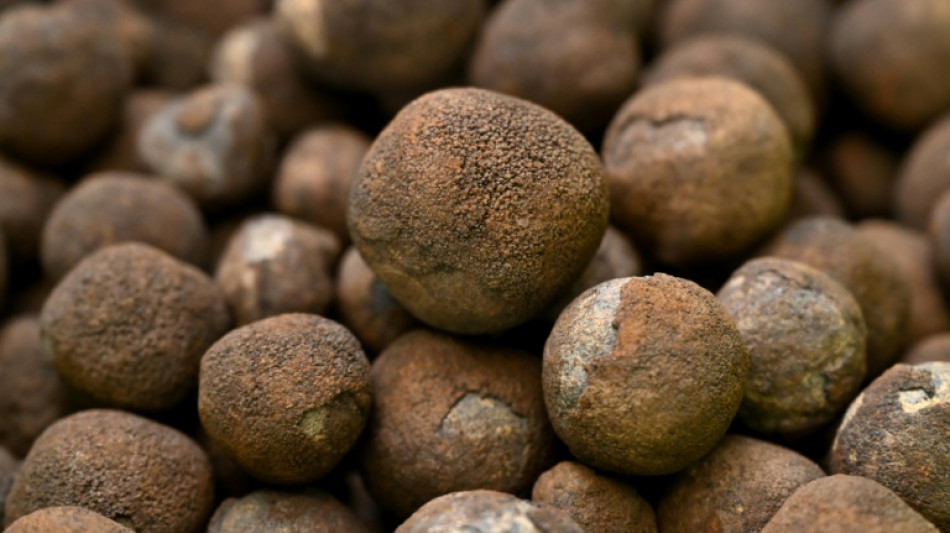
US finalizes rule for deep-sea mining beyond its waters / Photo: William WEST - AFP/File
President Donald Trump's administration on Tuesday issued a new rule to fast-track deep-sea mining in international waters, bringing the United States a step closer to unilaterally launching the controversial industry.
The National Oceanic and Atmospheric Administration's 113-page document consolidates what is currently a two-step permitting process -- one for exploration and another for commercial recovery -- into a single review, thus reducing environmental oversight.
It claims authority under the 1980 Deep Seabed Hard Mineral Resources Act to govern harvesting of minerals in areas beyond US jurisdiction.
"Over the past decades there has been a vast improvement in the technological capability for deep seabed mining, and the industry has obtained a substantial amount of information from deep seabed exploration activities," a document posted to the Federal Register said, justifying the consolidation.
But Emily Jeffers, a senior attorney at the Center for Biological Diversity, pushed back against the idea that scientific understanding of the deep ocean has advanced in leaps and bounds, adding the seabed remains one of the planet's last largely unexplored frontiers, where scientists are only beginning to grasp how ecosystems function.
"By issuing the permit simultaneously, they're committing to exploitation without the information that you would need to evaluate its impacts," she told AFP.
The rule follows an executive order signed by President Donald Trump last April directing agencies to streamline processes in a push to harvest seabed minerals, including rare earth elements critical to clean energy and defense technologies.
Teeming with mysterious species, the ocean floor has become a coveted frontier for companies and countries seeking access to minerals in high demand for technologies such as electric vehicles.
Swathes of Pacific Ocean seabed are carpeted in potato-sized "polymetallic nodules" containing cobalt, nickel, copper and manganese.
Scientists, however, worry that mining could smother species through sediment plumes or release heavy metals that move up the food chain.
Canadian firm The Metals Company has emerged as a frontrunner in the race, seeking to explore for minerals in the Clarion-Clipperton Zone of the Pacific Ocean.
That prospect has unsettled the United Nations' International Seabed Authority, which issued a veiled warning about TMC's potential activities last year.
ISA-member countries are deeply divided over how to proceed, with a growing number calling for a moratorium.
French President Emmanuel Macron has said it would be "madness to launch predatory economic action that will disrupt the deep seabed, disrupt biodiversity, destroy it and release irrecoverable carbon sinks -- when we know nothing about it."
The United States is not party to the ISA or to the UN Convention on the Law of the Sea (UNCLOS), under which the authority was established in 1994.
A.Wallace--EWJ