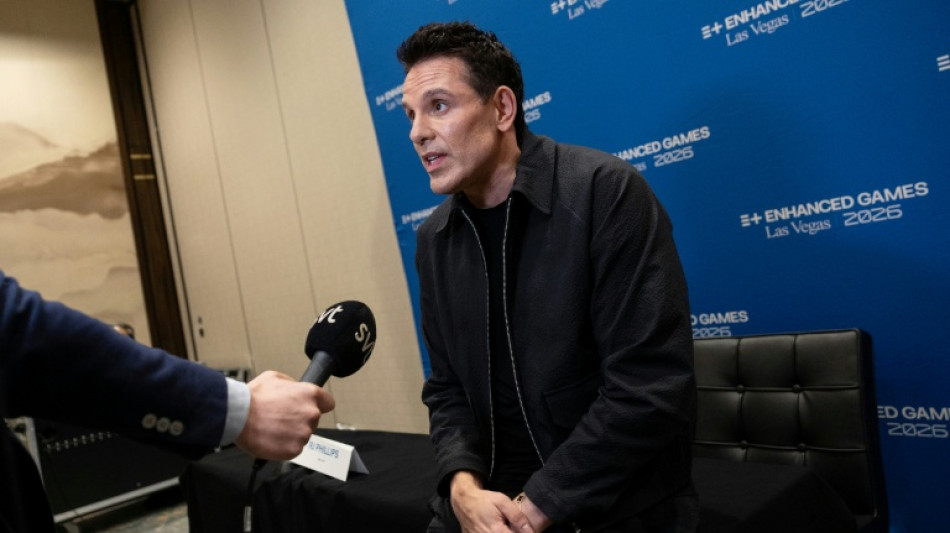
'Humans want to optimize': Enhanced Games founder embraces doping row / Photo: ETIENNE LAURENT - AFP
Love them or loathe them, the Enhanced Games have struck a nerve.
The multi-sport competition taking place this weekend in Las Vegas -- where sprinters, swimmers and weightlifters are free to dope on performance-enhancing substances -- has grabbed headlines around the world.
For Christian Angermayer, the German billionaire co-founder and long-time "biohacking" evangelist, it is no surprise at all.
"Humans want to optimize themselves, throughout history," he told AFP, on the eve of the divisive event.
"The foundation of our Western model -- the entire Greek mythology -- is based on demigods, or humans who are elevated, and to do things which are outside" the abilities of ordinary people.
"The whole word hero, the hero mythology -- which, by the way, literally our storytelling is based on -- is based on being an outstanding human being."
For critics of the Enhanced Games, who include world athletics governing bodies and anti-doping agencies, such lofty comparisons are nothing short of dangerous.
Skeptics fear that not only could athletes do themselves long-term harm, but that members of the public, enthralled by the event, may buy dangerous experimental supplements to "enhance" themselves without medical supervision.
World Anti-Doping Agency chief Witold Banka called the Enhanced Games a "dangerous" event that "must be stopped."
Unsurprisingly, Angermayer -- who made his fortune in cryptocurrency and is also an evangelist for deregulating psychedelics -- disputes these fears as "brainwashing."
While it is no secret that the Enhanced Games are a showcase for the testosterone and peptide medications that organizers are selling, Angermayer says every substance involved has been approved by the US Food and Drug Administration.
Athletes have undergone rigorous medical screening throughout the training process. The only side effect reported by athletes who spoke to AFP was "some water retention," cited by Olympic silver medallist swimmer Ben Proud.
"It's such a strong-held, wrong, belief... this whole idea, for example, that performance-enhancing drugs are horrible for you. It's not right," says Angermayer.
- 'So many stories' -
His view is vehemently rejected by many scientists.
University of Birmingham sport science professor Ian Boardley told AFP that several of the substances could risk "life-shortening and fatal consequences," including heart, liver and kidney issues, as so little is known about their long-term effects.
Angermayer counters that "it takes 10 years to approve a drug, so you at least have always 10 years of data," and says the true danger lies with people sourcing dubious supplements from the black market.
Enhanced Games organizers this week revealed that 91 percent of its athletes are using testosterone, 79 percent have taken human growth hormone, and 29 percent have been administered anabolic steroids.
Multiple athletes told AFP they experienced unprecedented physical improvements and enhanced recovery times while training for four months in Abu Dhabi prior to the Enhanced Games.
They also widely expected world records to be beaten. While any such achievements would not count as official records, any athlete that sets a new best time in the 100-meter sprint or 50-meter freestyle swim will earn $1 million.
For Angermayer, records set during the Enhanced Games would not supplant existing world records, but instead be the first benchmarks in a separate category of records for doping athletes.
But while those headlines would be useful for his company's bottom line, Angermayer says he wants future editions of the Enhanced Games to pivot away from maximizing the records of elite athletes, and showcase the improvements possible for more ordinary people.
That could include competitions for over-50s trying to emulate the feats of their youth, or soccer players and "cocky 22 year old YouTubers" trying to beat established track athletes who are racing clean.
"None of us, including me, will ever break a world record. But maybe you want to lose weight," he says.
"There's so many stories we can tell."
Ch.Anderson--EWJ