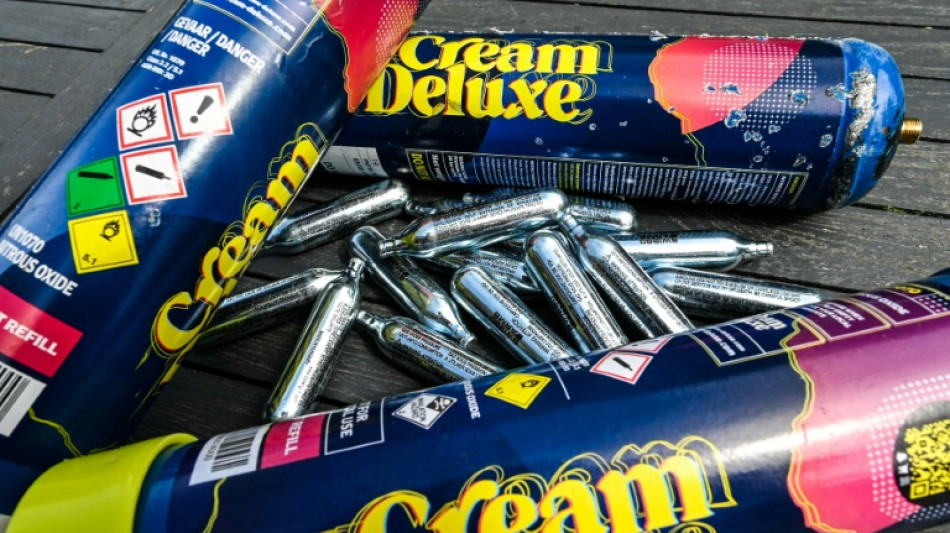
'No fun': French hospital confronts laughing gas abuse / Photo: Denis Charlet - AFP
A 21-year-old man scrolls through Snapchat ads on his phone promoting nitrous oxide, a sedative gas increasingly used by young people in France to get high.
"Honestly, in France it's way too easy to get hold of," he said.
The young man, who spoke to AFP on condition of anonymity due to stigma surrounding drug use, said he "got hooked" on the colourless and odourless substance commonly known as laughing gas when he tried it in 2021.
"I was doing it every day, every evening," he said in Bron, just outside the southeastern city of Lyon.
"After two or three years of using, I told myself I needed to get help, because of the after-effects."
The Lyon resident, who has complained of muscle weakness, is a patient at the Hospices Civils de Lyon (HCL), one of France's leading university hospitals.
The hospital is home to France's pioneering teleconsultation programme which is helping healthcare providers to better understand and treat the gas's toxic effects.
Nitrous oxide is used for pain relief in dentistry and medicine, as well as in catering.
In recent years, misuse of the inexpensive gas has become widespread in France among teenagers and young adults, who often use it as a party drug and inhale it via balloons filled from metal canisters.
A 2021 law prohibits the sale of laughing gas to minors, but it is still legal in France for individual adults to buy the gas.
- 'Complicated to drive' -
Recreational use produces feelings of euphoria, relaxation and dissociation from reality.
But long-term misuse can cause damage to the nervous system, impair cognitive functions, and lead to problems with balance and reflexes.
Apart from life-threatening health problems, the gas has caused fatal traffic accidents in France in recent years.
Reports of intoxication tripled between 2022 and 2023, according to the interior ministry.
Now the government has launched an awareness campaign, and Interior Minister Laurent Nunez advocates criminalising the inappropriate consumption of the gas, which would be punishable by one year in prison and a fine of 3,750 euros.
Doctors at HCL treat former and current users who might be experiencing long-term cognitive and other effects.
One of the users said she sought treatment when she began to worry about experiencing pins and needles in her legs and arms.
"It's becoming very complicated, even just to drive. When it hits me, the tingling -- it hurts a lot," said the 23-year-old woman, who also spoke on condition of anonymity.
After having been hospitalised for her pain, she went for a follow-up appointment at the HCL.
The woman said the treatment -- including with B12 vitamin -- was helping.
"I remember more things -- the B12 really helps me a lot," she said.
Since the service was launched in November 2024, addiction specialist Christophe Riou has conducted 150 telemedicine consultations and 60 in-person consultations with patients aged 15 to 31.
The service aims to take care of patients as soon as possible after their first symptoms appear, with doctors paying particular attention to pinprick sensations, loss of balance and muscle weakness.
"We're trying to bring patients together under a single care pathway. That makes it easier to understand and coordinate care," Riou said, a nitrous oxide cylinder sitting on his desk.
- 'Eternal regret' -
He said doctors were learning more about the neurological effects of the misuse of the gas, particularly leg paralysis.
"We are also beginning to see that this neurotoxic effect acts at the level of the brain," he said, adding this helped explain changes in behaviour, even outside episodes of acute use.
Riou also said that introducing legal consequences for the consumption of the gas may encourage users to seek treatment.
"This may help people realise that it poses a problem, and this could in turn encourage them to seek care," he said.
Citing test results of the heavy users, Yara Malaeb, a neuropsychology trainee, said such patients show memory and attention difficulties.
"These are young people who, for their age, are not functioning normally," she said.
The 23-year-old woman patient called nitrous oxide "the worst drug ever".
"I really wish I could tell young people not to do this. But the problem is, they already know," she added.
The 21-year-old man said inhaling laughing gas made him noticeably weaker, particularly in his legs, and he struggled to keep his balance while walking.
"It's no fun," he said, adding misuse of the drug can destroy a life. "It's a fleeting pleasure for eternal regret."
Ch.Thomson--EWJ