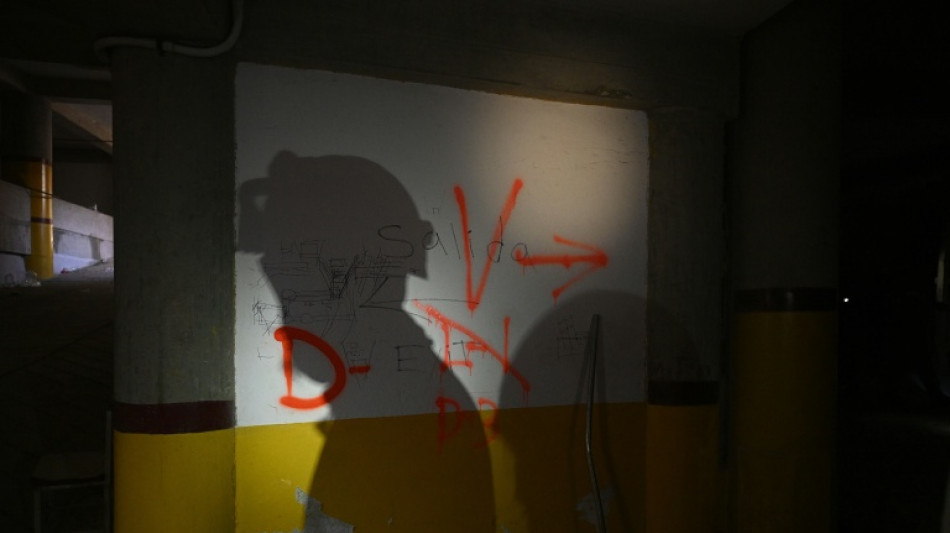
Macabre night in La Guaira, Venezuela's earthquake epicenter / Photo: Federico PARRA - AFP
A macabre darkness, the glare of spotlights, the droning of generators and jackhammers, and often the stench of decomposing corpses: eight days after the double earthquake in Venezuela, nighttime in La Guaira, once a festive seaside resort, has transformed into a grim scene of survival and despair.
The vast majority of the nearly 2,300 dead and thousands missing from the tragedy of June 24 are concentrated on the coast of La Guaira, where entire neighborhoods have been razed.
Nearly 200 buildings have completely collapsed, according to official figures, but local people say the number is higher.
Some 15,000 homeless people are sleeping in tents in the streets, sports facilities, parks, vacant lots after one of Latin America's worst ever earthquake disasters.
Everywhere, relatives, volunteers, and rescue workers are racing to recover bodies with the slim chance of finding survivors.
But there have been glimmers of hope. Hernan Gil, 43, was astonishingly rescued from the rubble on Thursday, eight days after the earthquakes, in Playa Grande, a neighborhood of Catia La Mar.
- "Sandwich of slabs" -
On a neighboring plot of land, under the glare of floodlights, about 10 people are working to excavate a six-meter-high mountain, the remains of an eight-story building that collapsed "like a sandwich of slabs," explained Manuel Alejos, a crane operator.
"We're breaking slab by slab to free the bodies... Their families need the bodies to say their goodbyes," said the crane operator, who has already pulled seven bodies from the building.
"We still have the basement to do," he said, still hoping to find survivors.
The stench of corpses filled the air.
Angelo Gonzalez, a 27-year-old motorcycle taxi driver, and his friends arrived with water and pasta: "We're helping our brothers. We all have the same blood."
On the docks, people wait on plastic chairs. A makeshift morgue has been set up to meet the demand.
Owuar Herrera and 12 members of his family have been waiting since 5 p.m. He brought the bodies of his granddaughter, 10-year-old Dasleidy Herrera, and her grandmother, 50-year-old Mildred Moreno, both killed in the earthquakes.
"After a week of work, we found them today. They were embracing," he says.
In Caraballeda, the other hardest-hit area, only a pile of rubble remains of the upscale Coral Beach residence.
At the top, men were also working with spotlights to recover the body of Dennis Velasquez, 26, the son of their friend.
Plastic bottles had been placed over the protruding metal to prevent injuries. The men worked like ants, forming a chain to pass buckets of small concrete blocks.
"We went past the penthouse, the 12th floor, and on the 11th we pulled out a family of six with a six-year-old child. On the 10th, there's my son," one of the rescuers, Carlos Velazquez, said.
"I've been here since day one. Even if I have to pull him out with my own fingernails, my son will rest in a proper cemetery," Velazquez said, his eyes filled with sadness but determination.
His son's body was recovered shortly afterward.
Cesar Gonzalez, 54, a Mexican firefighter and veterinarian, gives his two dogs, Zeus and Bom, water: "One is for detecting the living, the other for the dead. The more time passes, the less hope there is. Just two days ago, hope was much greater. Now, it would be a miracle," he explains.
- Already looted -
Police and soldiers are patrolling to prevent looting. Sergeant Yonder Maita, 24, is patrolling to protect rescue workers but especially to prevent theft: "There are people who break into houses to steal. Sometimes they pretend to be relatives. They take advantage of the situation."
On many walls, the words "Already looted" are painted in black.
On a soccer field, Maria Arteaga, 33, a mother of four, is preparing to sleep in an improvised shelter made of tarpaulins and a Venezuelan flag.
On the floor, dirty mattresses found in the street will serve as sleeping quarters for nine people.
"The house... Everything, we've lost everything... Except our lives! We're even barefoot."
"We didn't have much to begin with, but we've lost everything," adds a neighbor, Alexis Ramirez, 25, a tire repairman.
He lives with his two-year-old daughter, Mia, his wife, Fabiola, who is seven months pregnant, and his disabled mother-in-law.
Is he afraid of becoming homeless? Of more aftershocks? Of thieves?
"We've lost our fear.”
pgf/dth/pma/dw
N.M.Shaw--EWJ