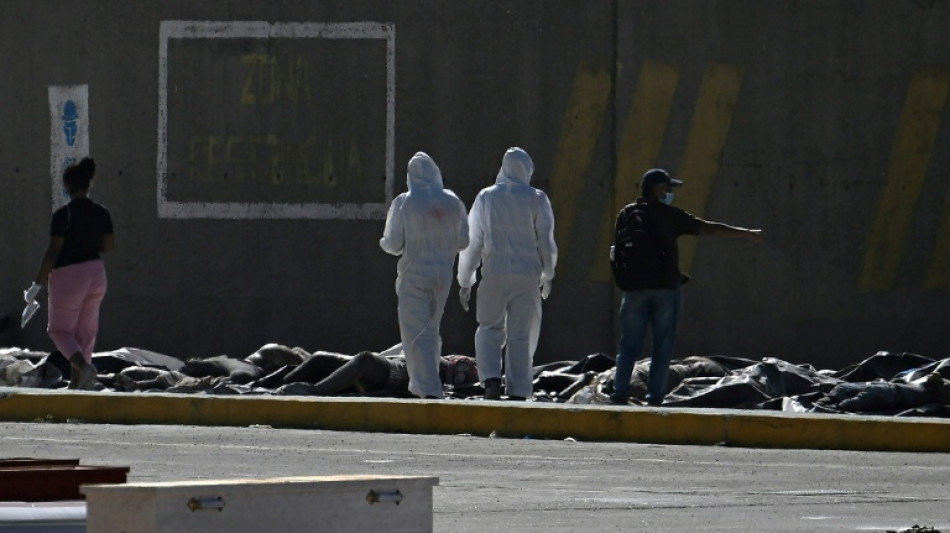
'I recognized her ring': identifying Venezuela's dead in a makeshift morgue / Photo: Federico PARRA - AFP
At a makeshift morgue in the quake-hit Venezuelan port of La Guaira, forensic experts in blue gowns and caps picked their way through dozens of bodies laid out in bags under the sun.
The back-to-back 7.2- and 7.5-magnitude earthquakes that rocked the Caribbean country within seconds of each other devastated this coastal state near Caracas, reducing entire neighborhoods to rubble.
As the official death toll rose past 1,700 and hospital morgues overflowed, the dock has been transformed into a mortuary, dotted with body bags and coffins.
Some of the bodies have been covered in lime to slow their decomposition.
Near a white tent, about a hundred empty urns awaited ashes of the dead after cremation.
"My family is in there. They tell me my sister and her children are there, and my brother's children," 25-year-old Wilker Molalla told AFP as he waited to be called to identify his dead.
Out of his family of 11, only Molalla and his brother survived.
They were at work when the quakes struck, causing high-rise apartment buildings, shopping centers and schools to crumple.
Carrying bouquets of flowers, relatives arrived to identify their loved ones or receive their bodies for burial.
Many were fiercely critical of the state's handling of the disaster, which has left residents in some places digging through rubble with their bare hands to try reach trapped family members.
- Identified by a ring -
Doctors and forensic experts in the port examined bodies under tarpaulins held up by four poles before issuing death certificates and cremation authorizations.
A truck identified as the "Special Hospital Waste Unit" arrived to collect the autopsy waste.
"I came yesterday and walked everywhere and couldn't find my daughter," said a distraught Antony Marcano, a 41-year-old cook.
"Today I returned more calmly, and thank God I found her, I identified her," he added.
"I recognized her by the ring I gave her."
Marcano participated in the recovery of his daughter's body, unrecognizable except for her clothes and the ring.
Authorities have given no estimate for the number of people still buried under the rubble, but the UN has estimated that there are about 50,000 people unaccounted for and said it is sending 10,000 body bags.
- A proper burial -
As part of the outpouring of solidarity from Venezuelans, many private funeral homes have offered free hearses to transport the dead, and free cremations.
Darwin Silva, 37, came to collect the remains of his mother, who died in the Hugo Chavez social housing complex, a flagship program of the late strongman leader.
"She's been identified, they already gave me the death certificate," said a distraught Silva, 37.
His mother was found trapped under a fallen beam, late at night, using a generator set up by neighbors for light.
The identification of the dead has been slowed by the fact that some relatives are still recovering from their injuries in hospital.
Marcano advised other families to keep the faith as they begin the grieving process.
"Pray to God that you can give them (your relatives) a proper burial," was his advice.
P.Mitchell--EWJ