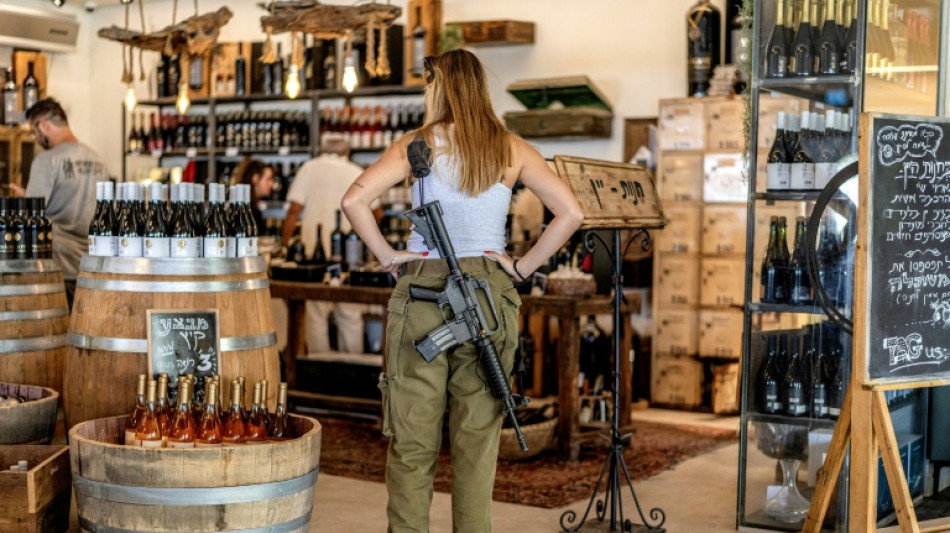
Israeli settlement winemaker defiant after UK-led trade sanctions / Photo: Ilia YEFIMOVICH - AFP
Britain has said it will have nothing more from Israeli settlement businesses like Psagot winery in the occupied West Bank. But on Wednesday, as the clink of bottles mingled with chatter from customers, some armed with automatic weapons, the owners were defiant.
Britain a day before led allies in a ban on exports from Israeli settlements in the West Bank, which are illegal under international law, accusing settlers of "ethnic cleansing" through their rising attacks on Palestinians.
Despite Britain being an important export market for the Psagot winery, co-founder Yaakov Berg downplayed the economic impact of sanctions, vowing to stay on the land and grow his business.
"Of course we'll lose some sales, but in the long term, I promise you, you come here in a year and in two years and you will see that Psagot winery sales will go more and more and more," he told AFP in the Israeli settlement of Shaar Binyamin.
"The impact of that stupid and really cruel decision will be for the English people much more than us. The English people will suffer from that decision," he added.
Britain, France and Canada on Tuesday said they were imposing trade curbs on Israeli settlements in response to rampant violence by settlers against Palestinians in the West Bank.
The move comes as Israeli settlement construction soars in the Palestinian territory, which the Western allies said posed an urgent threat to a two-state solution to the conflict.
Nine other European countries joined a statement saying they planned to introduce or support restrictions on trade with settlements.
Israeli settlements mainly export agricultural products, as well as wine, Dead Sea cosmetics and industrial products.
There is no precise public data in Israel on settlement exports, and their products are generally counted among Israel's foreign trade, making their origin difficult to trace.
According to Calcalist, Israel's leading business daily, settlement exports account for less than one percent of Israel's total exports of goods and services.
- 'Build more homes' -
At the Psagot winery on Wednesday, business was buzzing.
Customers, some armed, milled among tables pushing babies in prams, while an employee carefully packed boxes with wine.
Berg, who started Psagot winery some 20 years ago, said the business exports about 60 percent of its production, with trade in Britain, the United States, Europe, South America and elsewhere.
"You can find our wines really almost everywhere on Earth," he said, noting that exports to the UK accounted for around $1 million a year.
Berg said his business had faced boycott calls since it launched and he was "not afraid" of the latest measures.
"You're not going to change us because of some dollars," he told AFP.
"We came to our homeland... and we believe in what we're doing," he added.
"We didn't come here for some dollars, so we're not going to move because of some dollars."
More than 500,000 Israelis live among some three million Palestinians, with settlement approval soaring under Prime Minister Benjamin Netanyahu's right-wing government.
From a sunny gravel seating area at Psagot winery, the Palestinian village of Mikhmas could be seen on the neighbouring hillside.
Mikhmas and the surrounding area have been subjected to several attacks by settlers since the beginning of this year.
A nearby Bedouin community was displaced from the area in February, citing sustained harassment from settlers.
Berg questioned the soaring levels of violence in the territory and slammed the sanctions by the UK and allies as "pure antisemitism".
The move appeared if anything to have galvanised his resolve to stay and expand Israel's presence.
Addressing British Foreign Secretary Ed Miliband, who unveiled the sanctions on Tuesday, Berg vowed to put his money "in the land".
"We'll grow more grapes, and we'll build more homes, and we'll stay here," he said.
St.Ch.Russell--EWJ