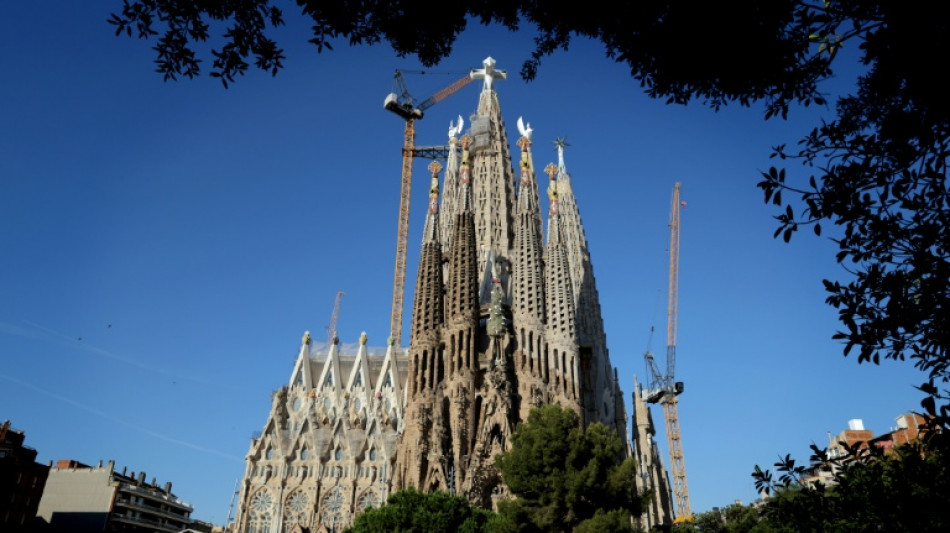
Pope to mark centenary of death of 'God's architect' Antoni Gaudi / Photo: Thomas COEX - AFP
Pope Leo XIV will celebrate mass next week at Barcelona's Sagrada Familia, the unfinished basilica designed by famed architect Antoni Gaudi, a fervent Catholic whose cause for sainthood is advancing in the Vatican.
Last year, nearly five million people visited the Sagrada Familia -- known for its soaring towers and symbolism-rich modernist architecture -- making it Spain's most visited paid monument.
Other Gaudi landmarks, including the brightly coloured Casa Batllo in the centre of Barcelona, also continue to attract large crowds.
"He was a genius," Casa Batllo director Xavier Villanueva told AFP. "He knew how to reach people at their deepest level."
Gaudi died June 10, 1926, at age 73, days after he was hit by a tram in Barcelona while on his way to pray at a church.
The pope, who is set to visit Spain from June 6 to 12, will celebrate an evening mass at the Sagrada Familia on June 10 to mark the 100th anniversary of the architect's death.
The mass comes after the Vatican last year declared Gaudi, once called "God's architect" for his work on the Sagrada Familia, to be "venerable", a move toward sainthood.
Born in 1852 into a devout Catholic family, Gaudi quickly became one of Barcelona's most prominent architects.
Leading members of the city's bourgeoisie and business community entrusted major projects to the young architect, known for his strong temperament and his deep appreciation of nature.
- 'Man of God' -
Gaudi's life changed after a series of deaths among close relatives, which led him to undertake an extreme fast in 1894.
For the architect, already recognised for his work and his defence of Catalan identity, it marked the beginning of a new phase defined by a deep religious faith.
"It was really at that moment that he began to place himself after God," said Armand Puig Tarrech, a priest and theologian who helped prepare a 1,700-page dossier submitted to the Vatican seeking Gaudi's beatification, the next step on the path to sainthood.
Before, Gaudi "remained internally attached to very human things such as vanity or ambition", he added.
After this formative existential crisis, Gaudi adopted an austere, almost mystical lifestyle, leading some of his most fervent admirers to view him as a potential saint.
"If you look at his life, you see a man of God," said Jose Manuel Almuzara, one of the co-founders in 1992 of the Association for the Beatification of Antoni Gaudi.
Before Gaudi can be beatified -- the final step before sainthood in the Catholic Church -- a miracle attributed to his intercession must be verified.
The association has collected testimonies of favours believed to have been granted by his intercession, and the Vatican's medical commission is currently studying a possible miracle.
- 'Something of a miracle' -
Gaudi, who was known for his quick temper, remained single throughout his life, disliked having admirers and even refused to be photographed, according to his biographers.
Today, millions of people visit his works, which have become a lucrative symbol of mass tourism in Barcelona despite the architect's apparent discomfort with fame.
"When a brand grows, there are always official uses and others that seek to capitalise on it," said Galdric Santana, an architecture professor at the Polytechnic University of Catalonia and coordinator of a series of events commemorating the centenary of Gaudi's death.
The Sagrada Familia will be the focus of global attention again on June 10 when the pope blesses the basilica's Jesus Christ tower, the soaring central piece, which was completed in February.
The tower brought the basilica to its maximum height, 172.5 metres (566 feet), making the Sagrada Familia the world's tallest church.
Full completion of the Sagrada Familia is expected in about a decade.
"The most obvious miracle, to me, is that he created a work that everyone wants to see," said Gijs van Hensbergen, author of a biography of the Catalan architect.
"Atheists, Buddhists and people from all over the world come to Barcelona to see this building, which is itself something of a miracle."
M.Stevenson--EWJ