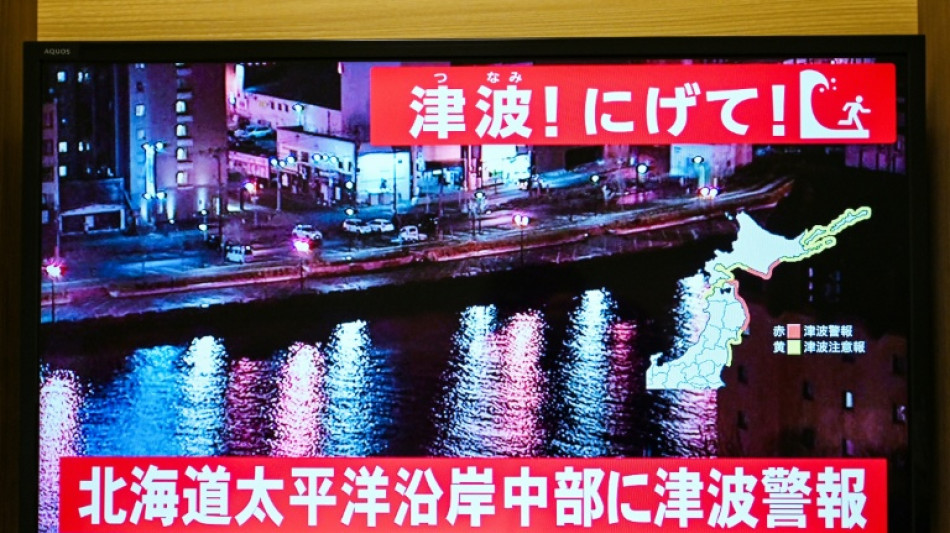
Powerful 7.6 quake strikes off Japan, tsunami warning lifted / Photo: GREG BAKER - AFP
A major earthquake rocked Japan's northern coast on Monday, with the country's meteorological agency recording several tsunami waves and local media reporting injuries.
The magnitude 7.6 quake -- which struck off Misawa on Japan's Pacific coast -- reportedly forced residents to flee their homes and left thousands of people without power.
The Japan Meteorological Agency issued a tsunami warning, with one wave hitting a port in the northern region of Aomori, where Misawa is located.
Several more waves reached the coast, measuring up to 70 centimetres (two feet four inches), JMA reported.
Early on Tuesday the agency lifted the tsunami warning, according to Kyodo news agency, although JMA said lower-grade advisories remained in effect for parts of northern Japan.
Public broadcaster NHK cited a hotel employee in the city of Hachinohe in Aomori as saying there had been some injuries as a result of the quake, which hit at 1415 GMT.
The US Geological Survey recorded the temblor at a depth of 44 kilometres (27 miles).
Live footage showed shattered glass fragments scattered across roads.
Hachinohe residents fled their homes to seek shelter in the city hall, NHK said.
Some 2,700 homes in Aomori were without power, according to Kyodo, and there were numerous reports of fire.
The quake was also felt in the northern hub of Sapporo, where alarms rang on smartphones to alert residents.
A reporter for NHK in Hokkaido described a horizontal shaking of around 30 seconds that made him unable to remain standing as the earthquake struck.
The meteorological agency earlier warned a tsunami of up to three metres (10 feet) was expected to hit Japan's Pacific coast.
Top government spokesman Minoru Kihara had urged residents to stay in a safe place until the warning had been lifted.
The area could see strong quakes in the coming days, the government warned in a separate press conference.
- 'Megaquake' -
Kihara said he had "received no reports yet of abnormalities" from two nuclear power plants in northern Japan, adding that probes are ongoing in other nuclear facilities.
In 2011, a magnitude-9.0 quake triggered a tsunami that left 18,500 people dead or missing and caused a devastating meltdown at the Fukushima nuclear plant.
Shortly after Monday's earthquake, Tohoku Electric Power said in a post on X that the safety equipment at its Higashidori nuclear power plant in Aomori and its Onagawa nuclear plant in the Miyagi region had not shown any abnormalities.
Japan sits on top of four major tectonic plates along the western edge of the Pacific "Ring of Fire" and is one of the world's most tectonically active countries.
The archipelago, home to around 125 million people, experiences around 1,500 jolts every year.
The vast majority are mild, although the damage they cause varies according to their location and depth below the Earth's surface.
Quakes are extremely hard to predict, but in January a government panel marginally increased the probability of a major jolt in the Nankai Trough off Japan in the next 30 years to 75-82 percent.
The government then released a new estimate in March saying that such a "megaquake" and subsequent tsunami could cause as many as 298,000 deaths and damages of up to $2 trillion.
B.Jamieson--EWJ