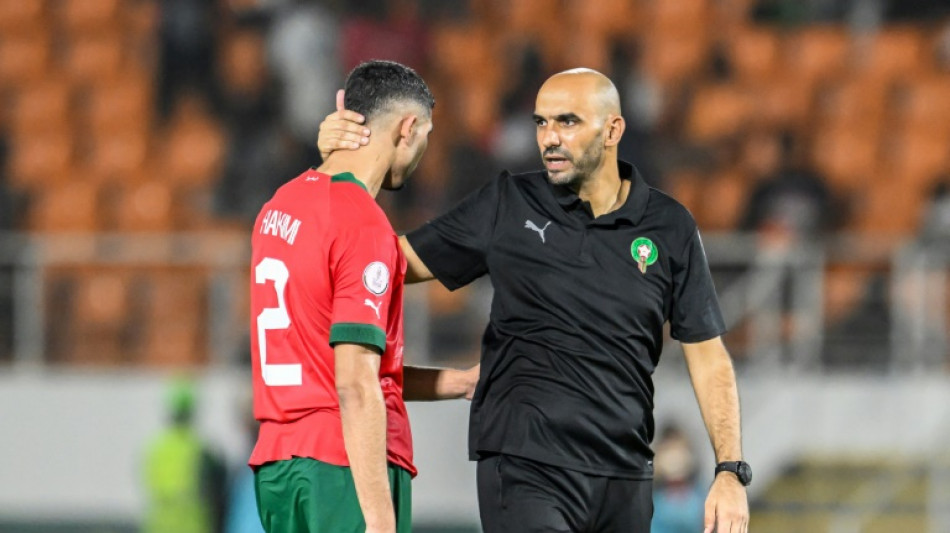
African heavyweights tumble like dominoes at Cup of Nations / Photo: SIA KAMBOU - AFP
From Ivory Coast's remarkable resurrection to heavyweight exits and underdog successes, there may never have been a more unpredictable major international football tournament than the ongoing Africa Cup of Nations.
The last 16 concluded on Tuesday with the continent's top-ranked team, 2022 World Cup semi-finalists Morocco, being dumped out by South Africa after Achraf Hakimi missed a crucial late penalty.
Tournament hosts Ivory Coast returned from the dead, narrowly escaping a humiliating elimination in the group stage, but this AFCON has already proven to be a graveyard for many of the traditional powerhouses.
"It is not the end of the world," insisted defeated Morocco coach Walid Regragui, whose country will host the next Cup of Nations.
"We are not the only ones. Lots of the favourites have been eliminated. We will come back stronger."
The three most successful teams in the history of the competition are out -- Egypt, Cameroon and Ghana have 16 titles between them but the first two were sent packing in the last 16 after the Black Stars limped out in the group stage.
All five of Africa's representatives at the 2022 World Cup have already gone home.
Senegal's exit on penalties at the hands of Ivory Coast continues a trend which has seen no reigning champion win a knockout tie at the Cup of Nations since Egypt in 2010.
Indeed, the last three champions have all been eliminated, with Algeria exiting in the group stage for the second AFCON in a row following their triumph in 2019.
- Hakimi, Mane, Salah out -
Mohamed Salah, Riyad Mahrez, Sadio Mane and Hakimi, four of the very biggest stars of African football, will watch the rest of the tournament on television, if they can even bring themselves to do so.
Most remarkably, none of the quarter-finalists at the last edition, two years ago in Cameroon, have reached the last eight this time.
That might suggest that the decision to expand the competition to 24 teams -– a change brought in from the 2019 edition in Egypt -– has helped make many smaller nations more competitive and created a greater strength in depth across Africa.
"There are no small teams anymore" has quickly become a bland cliche, and yet there is some truth to it.
In terms of pedigree, two names stand out among the quarter-finalists.
Nigeria, Africa's most populous country, have impressed with African player of the year Victor Osimhen leading from the front.
They look good bets for a fourth title, 11 years after their last, although there is a danger that might be a little too logical, given how the competition has been going.
Ivory Coast -– the only one of the top seeds when the draw was made who are still alive -- have twice been champions, including as recently as 2015. They also have the advantage that supposedly comes with playing at home.
Then again no host country has won the AFCON since Egypt in 2006, and the Elephants have been a basket case, suffering their heaviest ever home defeat as they almost went out in the first round, and then sacking their coach.
- History-makers -
Three of the last eight are into the quarter-finals after winning a Cup of Nations knockout tie for the very first time.
Angola, ranked 28th in Africa, will measure themselves against Osimhen's Super Eagles, while Guinea face the Democratic Republic of Congo.
Most striking of all has been the run of Cape Verde, the tiny Atlantic Ocean island nation with a population of 600,000.
They beat Ghana and drew with Egypt on the way to topping their group, before seeing off Mauritania.
Helped by players of Cape Verdean heritage born in countries such as Portugal, France, the Netherlands and Ireland, the Blue Sharks have been outstanding and face South Africa next.
"You can see that it is not easy for the big footballing nations to win games either now," Cape Verde captain Ryan Mendes told Canal Plus Afrique.
"They have players who play for big clubs, but us so-called small teams play with a lot of heart, and we have a lot of quality at the same time.
"We don't have the same status, but we do have love for our country as well as ability," he added.
T.Wright--EWJ