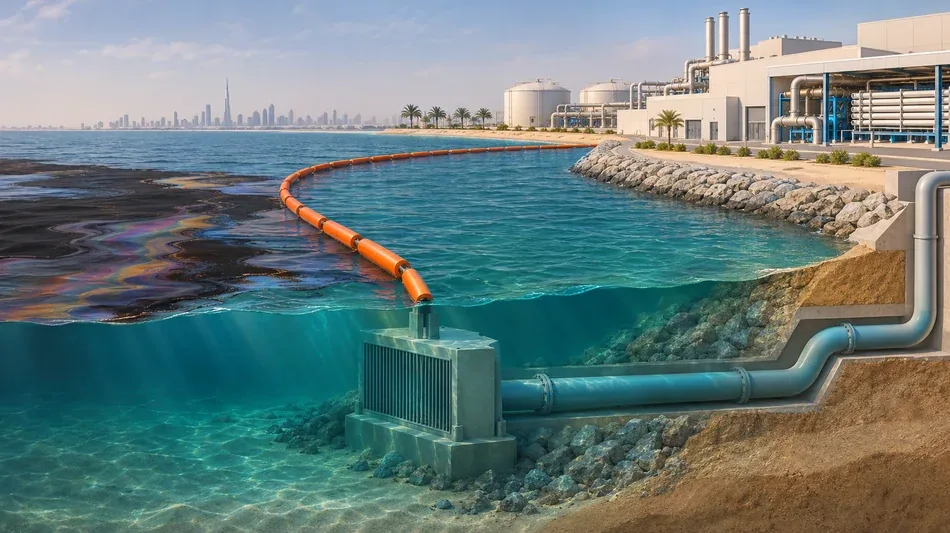
UAE oil spill raises questions for desalination operations
An oil spill off the United Arab Emirates that has prompted temporary restrictions on fishing and on access to several beaches has raised concerns over the risk of environmental contamination and the potential impact on desalination plants. The spill is from a vessel that shipping sources have identified as crude oil tanker Gem No.
An oil spill off the United Arab Emirates that has prompted temporary restrictions on fishing and on access to several beaches has raised concerns over the risk of environmental contamination and the potential impact on desalination plants. The spill is from a vessel that shipping sources have identified as crude oil tanker Gem No. 2.
The incident off the UAE has also raised questions about what impact oil spills can have on desalination plants, which crowd the Emirati coastline and, just as in other Gulf countries, are a supplier of water. In the UAE, desalinated water accounts for over 80% of potable water. significant plants include those at Dubai’s Jebel Ali industrial port, and at Taweelah between Abu Dhabi and Dubai.
Gulf desalination plants had already come under threat from direct hits in the conflict earlier this year. Maritime intelligence firm Windward said on Sunday that the leak threatened the seawater intake of the Naqa’a desalination plant at the border between Umm Al Quwain and Ras Al Khaimah.
Footage verified by Reuters showed that the oil slick had reached a location in Ras Al Khaimah about 2km (1.24 miles) from the plant. Water analysts told Reuters that it was hard to assess the potential impact on desalination plants without more information on the extent of the spill. So far, the UAE has not announced any shutdowns of plants.
The UAE Ministry of Climate Change and Environment, Ras Al Khaimah Media Office and the Naqa’a plant did not immediately respond to requests for comment. Any oil spill has the potential to impact the environment, but the extent of the damage depends on the type of oil and the volume, said Simon Boxall, a senior lecturer at the University of Southampton.
“Crude oil in particular is a natural product. And so crude oil will break down in the marine environment, particularly in the warm waters such as the Gulf, within a matter of a few weeks,” he said. “A thicker spill obviously carries more oil, and when it hits the beaches, when it hits the marine environment, both at sea, on the seabed, and on the coast, then it has a potential to cause more damage. It will eventually break down, but that does take time.”
For wildlife, it can be fatal. Plants need to be shut down as soon as oil gets anywhere near them to avoid contamination, said Boxall.
Nidal Hilal, director of New York University Abu Dhabi’s Water Research Center, said oil spills can threaten desalination plants even when the oil does not physically reach the plant, with the principal vulnerability being the seawater intake, which draws raw seawater into the facility for treatment. “For the UAE, where desalination is a cornerstone of drinking-water security, a central concern is whether the oil could reach seawater intakes and compromise the treatment process,” he told Reuters.
It is important to make a distinction between a threat to water quality, a temporary shutdown of a plant, and actual physical damage to the facility, he said. The most effective strategy is to establish several layers of protection rather than rely on a single intervention.
“For the current incident, the priorities should be to prevent oil from reaching desalination intakes, protect treatment equipment, and maintain a safe and reliable drinking-water supply,” said Hilal. Generally, recovery time depends on whether contaminated seawater entered the plant and if the incident causes persistent fouling and equipment damage, he said, listing plant design and the type and quantity of oil among factors that can also play a role.
Technical studies and previous incidents have shown that oil contamination can disrupt desalination operations and even damage treatment equipment, said Hilal. A significant spill in 1991 during the Gulf War was one of the largest in history, leading to several desalination plant shutdowns in Saudi Arabia and Kuwait and extensive shoreline contamination.
Ch.McDonald--EWJ