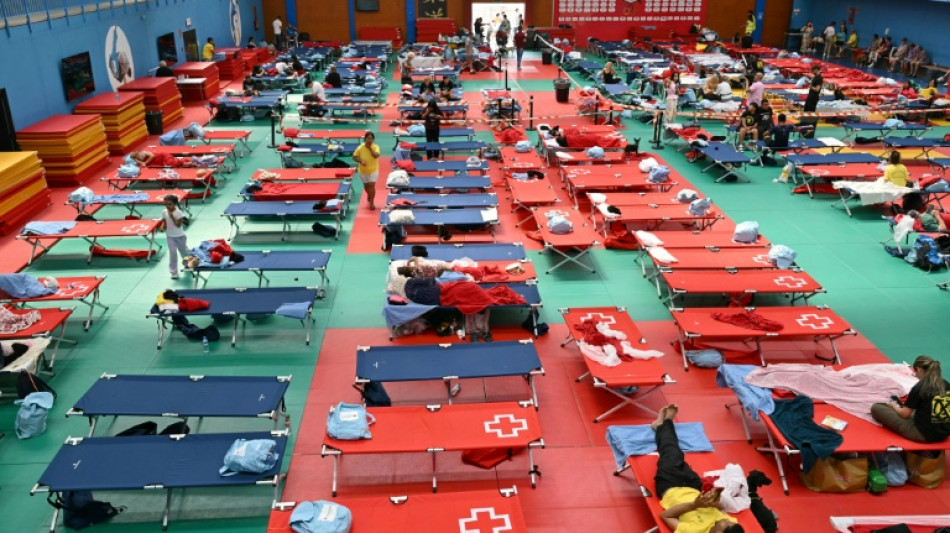
Close to Madrid, those who escaped flames worry what is next / Photo: JAVIER SORIANO - AFP
Elvira Menendez slept little last night. Her local municipal gym is nothing like home.
"There are dogs here, people snoring," says the resident of the village of Chapineria, evacuated on Friday to escape to the out-of-control fire west of Madrid.
Like some 200 other people, she found refuge in this large gymnasium in Villaviciosa de Odon, 30 kilometres (19 miles) from her home in the capital's suburbs.
Even tens of kilometres away from the blaze ravaging the Madrid countryside, the sky remained hazy with smoke Saturday morning before the winds cleared the air.
The historic El Escorial monastery -- a major tourist attraction -- was shrouded in a grayish, smoke-filled mist.
The fire has "surpassed all possible and imaginable limits," said Mar Nicolas, mayor of the nearby small town of Brunete, which is hosting around a hundred evacuees.
"The priority" was "saving lives," she said, though she made no secret of her concern regarding "the immense natural disaster this is causing".
Inside the Villaviciosa de Odon gymnasium, volunteers tried to keep children occupied with games and colouring activities, while others distributed meals after the evacuees had spent their first night sleeping on cots.
The volunteers "are taking good care of us; we were given blankets and facilities to shower," Elvira Menendez said.
"I'm 80 years old and I've never seen anything like this," she said. As the flames advanced, she was terrified that her "whole life" would go up in smoke.
By Saturday, the fire had already ravaged more than 25,000 hectares, and some 60,000 people had to be evacuated in the Madrid region and the province of Avila.
Victoria Hurtado, a 61-year-old home care worker, had to flee Chapineria with the elderly, sick man she cares for daily.
The two of them only had time to grab a small bag each, containing a few clothes and some medication.
"They welcomed us with open arms," she told AFP, though the uncertainty over when she might be able to return home still worried her.
But she remained optimistic, hopeful that the situation will improve "because firefighters are working night and day to put out the fire".
- Undergrowth -
The fierce fires ravaging parts of France and Spain are the result of forests and vegetation becoming more flammable because of drought and a series of record-breaking heatwaves that have hit Western Europe since May.
Antonio-Luis Rodriguez spent the night in the Villaviciosa de Odon sports hall with his son.
Having left with only the clothes he stood in, he was consumed with worry for his dog, left behind at his farm on the outskirts of the village of San Martin de Valdeiglesia, which was also evacuated.
Deeply affected by the ordeal and still in shock, the 48-year-old did not mince his words regarding the authorities, who he believes failed to sufficiently clear the undergrowth in the surrounding countryside.
"It rained a lot this winter; the pastures were very overgrown," Rodriguez said. He also lamented the fact that so many farms in Spain have been abandoned.
As a result, fallow fields are in a "deplorable state, and at the slightest spark, the blaze spreads like wildfire" due to vegetation dried out by the heat.
He put sheep in his fields when the grass was tall so they would clear away the vegetation, he said. Thanks to their grazing, he believed his farm was still standing, even if he knew "the surrounding plots were reduced to ash".
He was convinced that keeping more herds of goats and sheep in the mountains "would really help a lot" in controlling wildfires.
E.Brwon--EWJ