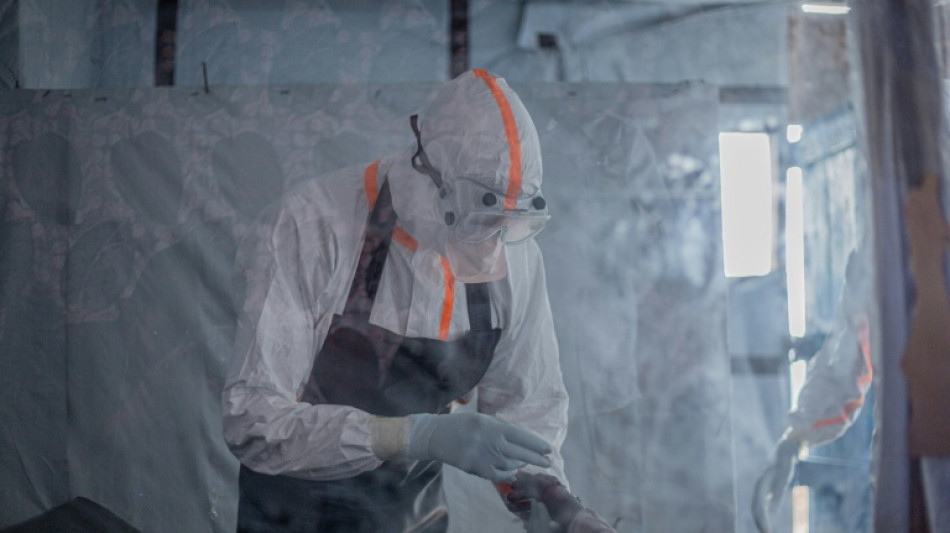
DR Congo Ebola outbreak killed more than 4,000: official figures / Photo: BENEDICTION MURHABAZI - AFP
The worst ever Ebola outbreak in the Democratic Republic of Congo has now killed more than 4,000 people out of more than 8,000 confirmed cases, Congolese officials said on Friday.
The outbreak, officially detected in mid-May, has hit unstable regions in the vast central African country where armed clashes and violence, alongside a critical lack of resources, have hindered the health response to the deadly virus in recent days.
According to latest official data, there have been 4,018 fatalities from 8,300 cases with 2,162 people recovering, giving a fatality rate to date of 48.4 percent.
Also recorded have been four deaths among six cases in North Kivu province in the northeast in areas controlled by anti-government group M23, the Kigali-backed group stated Friday.
After starting in Ituri, also in the northeast, the current outbreak has spread to seven provinces in the north and east.
The response has been hindered by conflict but also mistrust of authority which runs deep among inhabitants of several provinces.
Recent days have seen violent clashes between local militias that have hampered the response in Ituri, with more than 5,000 people displaced, the UN said on Thursday.
A transit centre for Ebola patients burned down Tuesday in the same province after soldiers entered a site for displaced people who promptly fled, according to the UN.
A contractor responsible for detecting cases was also killed in an attack on a health facility in North Kivu province, Congolese authorities said Wednesday.
French Foreign Minister Jean-Noel Barrot was due in Ituri capital Bunia on Friday to show Paris' support for local authorities and humanitarian workers.
There is no indication France is offering fresh humanitarian aid, but the country did allocate 13.4 million euros to the fight against Ebola between January and July.
The United States has meanwhile announced it is releasing a further $267 million to combat the spread of the disease.
Healthcare workers are notably at risk of contracting the virus in poor and remote regions where healthcare infrastructure is poor.
Several vaccines and treatments are currently being studied to combat the Bundibugyo strain of the Ebola virus, which is behind the current outbreak.
The first doses of the Ervebo vaccine -– which has been proven effective against the Zaire strain, the most common variant, in the past -– have been administered in recent weeks to volunteers among frontline staff as part of a clinical trial.
L.Ross--EWJ