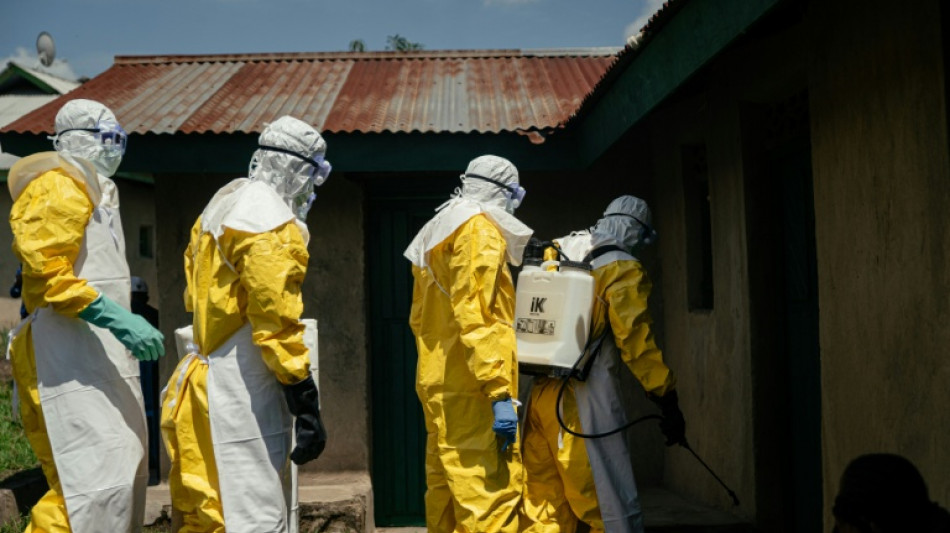
The vaccines and treatments being developed for Ebola outbreak / Photo: Jospin Mwisha - AFP/File
There are no vaccines or treatments for the strain of Ebola that has killed nearly 200 people in DR Congo and Uganda, but several are being urgently developed in the hope of reining in the outbreak.
More than 800 cases of the Bundibugyo strain have been confirmed in the two countries, including 192 deaths, since the outbreak was declared on May 15.
However the true scale of the outbreak remains unknown, humanitarian organisations have warned, because the virus could still be spreading in remote, poor and conflict-wracked areas of the Democratic Republic of Congo.
To help address the crisis, scientists, pharmaceutical companies and funding bodies have been racing to develop new vaccines and treatments that can be swiftly and safely tested in humans.
Here are the main options being considered.
- Vaccines -
The vaccine candidate the World Health Organization has dubbed "most promising" is based on the rVSV platform used to make the only licensed Ebola vaccine.
The new jab has been tweaked to target Bundibugyo, rather than the more common Zaire strain.
The WHO has estimated it will take seven to nine months before the new vaccine is ready to be tested in humans.
Thomas Geisbert, a virologist at the University of Texas Medical Branch who developed both rVSV vaccines, told AFP that "this maybe could be accelerated to six-seven months".
Another vaccine candidate, which uses the ChAdOx1 platform that underpinned AstraZeneca's Covid-19 shot, could be ready sooner.
It is being developed by the University of Oxford along with the Serum Institute of India, the world's largest vaccine maker.
US pharma firm Moderna is working on its own Bundibugyo vaccine that uses the mRNA technology it pioneered against Covid.
The Oxford and Moderna vaccines could be ready to start phase 1 trials in humans in two to three months, the Coalition for Epidemic Preparedness Innovations (CEPI), a non-profit organisation that funds vaccine research, told AFP on Thursday.
"If things go smoothly, this could be as early as July," a CEPI spokeswoman added.
CEPI has pledged millions of dollars to help develop the three vaccine candidates.
The deputy CEO of CEPI, Aurelia Nguyen, told AFP the "three bets" were on vaccine platforms that all "have different advantages, but also different weaknesses".
It remains to be seen which could prove effective, but it was important to have "all chances on our side," she emphasised.
Nguyen also pointed out that it took two years to bring a 2018 outbreak of the Zaire strain in DR Congo and Uganda under control -- even though vaccine doses were ready to be shipped within 72 hours.
- Treatments -
The WHO has also recommended prioritising three treatments for swift trials.
One is called remdesivir, an antiviral made by US pharma firm Gilead that used to treat Covid. Some lab data has indicated it could also work for Bundibugyo, but it has not been tested against the strain in humans.
Antivirals like Remdesivir pretend to be an important piece of RNA, but do not connect the viral chain, therefore blocking the virus from being able to replicate.
Another drug recommended by WHO is a monoclonal antibody called MBP134, developed by Mapp Biopharmaceutical, which targets Ebola viruses including Bundibugyo.
Monoclonal antibodies are proteins made to work like the antibodies of the body's immune system.
The third is a different monoclonal antibody called Maftivimab, developed by Regeneron.
"These candidates are being evaluated and will be advanced into clinical studies in affected countries as quickly as possible," leading pharmaceutical lobby IFPMA said this week.
Another Gilead drug called obeldesivir, which is the oral form of the intravenous remdesivir, has also demonstrated an ability to protect monkeys against two other Ebola strains -- but not yet Bundibugyo.
L.Ross--EWJ