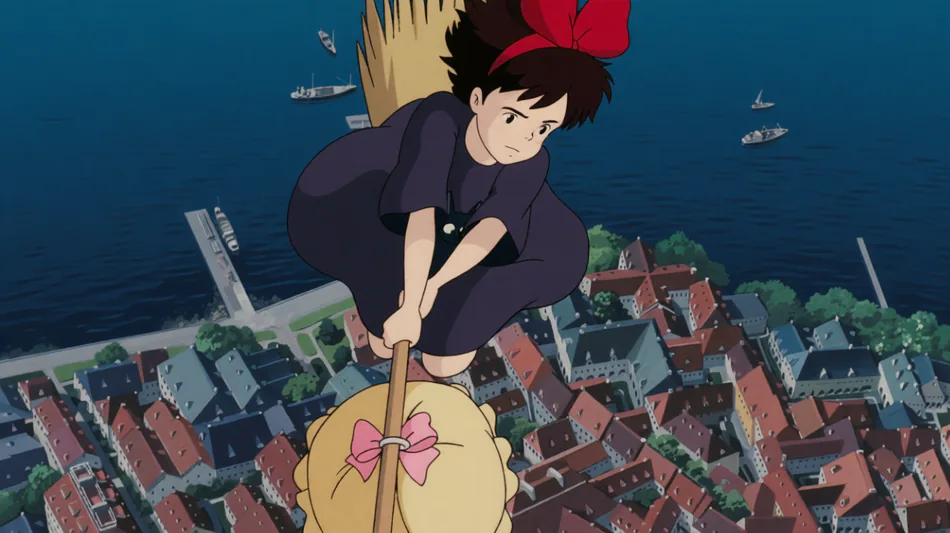
Kiki’s Delivery Service: A Feminist Milestone in Studio Ghibli’s History
Released in 1989, Studio Ghibli’s Kiki’s Delivery Service became the studio’s first major box-office success while establishing a distinct feminist perspective in Japanese animation. Director Hayao Miyazaki used the coming-of-age story to reflect the changing status of women in late-1980s Japan, blending magical fantasy with realistic portrayals of female independence and physical development.
Studio Ghibli’s 1989 animated feature Kiki’s Delivery Service stands as a pivotal work in the history of Japanese cinema, serving simultaneously as the studio’s first major commercial triumph and a nuanced exploration of female independence. While the film is widely recognized for its box-office performance, it also established a distinct thematic framework that director Hayao Miyazaki would continue to refine throughout his career: the portrayal of women navigating professional and personal autonomy within a male-dominated society.
Released on July 29, 1989, Kiki’s Delivery Service marked Miyazaki’s fifth feature-length film. Its production began during a period of intense creative output for the director, who was still working on My Neighbor Totoro when the proposal first reached Studio Ghibli. Initially, Miyazaki intended to serve only as producer and direct a younger creator, with Sunao Katabuchi, later known for In This Corner of the World, among the candidates considered for the directorial role. Ultimately, Miyazaki assumed four key roles: producer, director, screenwriter, and storyboard artist. His ability to release two films of exceptional caliber within two years highlighted his extraordinary work ethic during his late forties.
The narrative is adapted from the first half of a children’s book series by Eiko Kadono, published in 1985. While the source material contains strong elements of fairy-tale fantasy, Miyazaki substantially altered the story for the screen. He treated Kiki’s magical ability to fly not as a supernatural anomaly, but as an everyday skill, framing the narrative from a realistic perspective focused on an adolescent girl striving for independence.
The film’s commercial success was driven by significant corporate backing. The Japanese title, Majo no takkyūbin, contained the word takkyūbin, which is a registered trademark of the shipping giant Yamato Transport. This potential legal hurdle was resolved favorably when Yamato joined the film’s production committee. Additionally, Nippon Television invested in the studio for the first time with this release, launching a massive promotional campaign after later making Ghibli a subsidiary in 2023. This support helped the film break Ghibli’s streak of modest box-office returns. It generated ¥4.3 billion in revenue and drew 2.6 million admissions, eclipsing the all-time box-office record for an animated feature previously held by Farewell to Space Battleship Yamato: In the Name of Love (1978). It became the highest-grossing Japanese film of the year.
Critics have frequently analyzed Kiki’s Delivery Service as a form of male-authored feminist cinema, in which Miyazaki projects his ideals and expectations for women. The film places greater emphasis on motifs of female independence and women’s entry into the workforce than Kadono’s original book. This thematic focus stems partly from Miyazaki’s early career at Tōei Dōga (now Tōei Animation), where he was influenced by female creators such as Reiko Okuyama, Michiyo Yasuda, and Akemi Ōta, who would later become his wife. Witnessing their creative independence and struggles to improve labor conditions provided a foundation for the numerous working women depicted in his subsequent films, including Porco Rosso (1992), Princess Mononoke (1997), and Spirited Away (2001).
The film also reflected shifting social norms in Japan during the late 1980s. In 1986, the year after Kadono’s novel was published, Japan enacted the Equal Employment Opportunity Act, landmark legislation designed to redress discriminatory treatment against women in the workplace and catalyze their entry into the labor force. The film’s famous tagline, “I was feeling blue, but I’m better now,” conveyed both Kiki’s vulnerability and determination, projecting onto the young witch the image of a new generation of spirited 1980s women discovering their identities.
Kiki’s story follows a 13-year-old girl born to a witch mother. Following an ancient tradition, she departs her hometown on the night of a full moon with her black cat, Jiji. She lodges at a bakery in the seaside city of Koriko and launches a delivery service using her flying broomstick. Through interactions with locals, including a boy named Tombo, she grows toward adulthood.
The film is notable for its delicate portrayal of the physical and emotional turbulence of female adolescence. In the second half of the story, as Kiki grows closer to Tombo, an awkward moment strains their budding friendship. She subsequently finds herself unable to understand Jiji’s speech or fly her broomstick, plunging into an identity crisis. The climax occurs when a massive dirigible accident leaves Tombo dangling in midair. Her desperate resolve to save him reawakens her power of flight, allowing her to rescue her friend and overcome her self-doubt.
Kiki wins widespread recognition among the townspeople of Koriko for her rescue. Meanwhile, Jiji, who had previously functioned as an imaginary friend, remains unable to speak in human language. This change acts as a clear allegory for Kiki leaving childhood behind to become a socially independent adult. Some analyses extend this interpretation, reading the series of events as a metaphor for the onset of menstruation, wherein an adolescent girl’s physical abilities undergo temporary disruption as her body transitions toward greater maturity.
During production, Miyazaki sought to convey the reality of female adolescence by proposing an image of Kiki sitting on a toilet seat with a listless expression for the film’s promotional poster. Although this idea was rejected for risking misinterpretation, the completed film retains traces of this bodily focus. In one scene, the morning after moving into her bakery lodgings, Kiki is shown dashing to an outhouse toilet.
This attention to female physical development is a recurring element in Studio Ghibli’s work, though rarely noted. The studio has consistently depicted menstruation across its filmography. Takahata Isao’s Only Yesterday (1991), produced shortly after Kiki’s Delivery Service, features a flashback sequence involving the protagonist Okajima Taeko and a classmate named Rie experiencing her period. Takahata also depicts his title character experiencing her first period in The Tale of the Princess Kaguya (2013). Additionally, the Studio Ghibli television film Ocean Waves (1993) includes a scene where the character Mutō Rikako tells the protagonist Morisaki Taku that she is feeling unwell due to her period.
Kiki’s Delivery Service remains a significant milestone in Japanese animation for offering a distinctly feminist perspective. Although all of Studio Ghibli’s films have been directed by men, its works are frequently discussed in terms of gender, with Kiki serving as a prime example of this critical lens.
B.Jamieson--EWJ