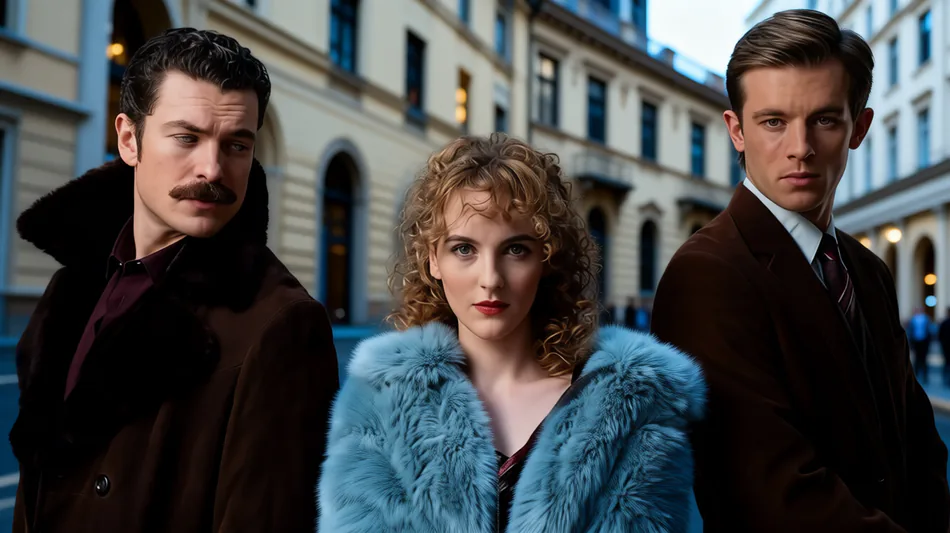
Honey Review: A Stylish, Comic Prequel to Killing Eve Set in 1980s East Berlin
Honey, the highly anticipated prequel to the hit series Killing Eve, launches with a visually striking and comedic take on Cold War espionage. Set in 1980s East Berlin, the show follows a young female spy navigating a world of paranoia and absurdity, offering a fresh, albeit sometimes predictable, entry into the genre.
The television landscape of the early 2020s has seen a resurgence of interest in Cold War espionage, with shows like Deutschland 83, Kleo, Star City, The Same Sky, and segments of The Americans capitalizing on the genre’s unique blend of danger, absurdity, and exotic kitsch. Into this crowded field steps Honey, a new series that positions itself as a prequel to Killing Eve. While the connection to the original show is nominally significant for branding, the review suggests it adds little substantive value to the viewing experience, as the tones and narratives diverge sharply.
Honey pitches its audience directly into an atmosphere of premium frosty paranoia from the very first scene. The opening sequence introduces British press attaché and spy handler Graham Anderson, played by Rory Kinnear, who endures a tense crossing back into East Berlin. His anxiety is palpable as he fears his car being searched, a fear exacerbated by a chortling border guard who inspects his vehicle with glee. The guard’s interaction culminates in a humiliating display of surveillance power when he remarks to Anderson’s wife, Anne, played by Sonita Henry, "Good luck for your smear test on Thursday, Mrs Anderson!" This moment establishes the show’s willingness to mix genuine tension with dark humor.
Following a sequence involving a car chase, a number plate swap, and a disguise involving a sheepdog costume, Anderson successfully smuggles a young agent named Martha into East Berlin at the height of the city’s intelligence battles. The narrative then jumps two years forward to 1982, where we find Martha, played by Ann Skelly, thoroughly unstimulated by her low-level assignments. Operating under the cover of a waitress in a dive bar frequented by middle managers, her job involves luring men home and photographing them in their underwear to generate kompromat.
Skelly delivers a confident performance as a woman who refuses to accept her place within any patriarchal hierarchy, even when such structures are ostensibly designed to protect her. Her character’s boredom leads to reckless curiosity, which in turn draws her into a fractious but sexually charged alliance with Kurt Fischer, a smoothly arrogant CIA agent played by Nate Mann. Simultaneously, she enters a perilous symbiosis with Friedrich Baumann, a Stasi traitor-hunter played by Jannis Niewöhner.
The series initially announces itself as a treat for espionage enthusiasts, boasting convincingly knackered interiors in distressed browns and deep greens that accurately reflect the era. The soundtrack features era-appropriate European pop, including a daringly brief opening title sequence set to music by Inner Space, precursors to the band Can. The show finds innovative ways to subvert familiar spy tropes; for instance, when Martha meets Anderson for a debriefing in a room suspected of being bugged, they foil the listeners not by playing white noise or running a tap, but by blasting a tape of sex noises.
However, as the season progresses, Honey settles into more predictable comedy-thriller rhythms. The narrative requires Martha to investigate a mysterious death alongside Kurt, while simultaneously hiding this from Baumann, who is also pursuing the same case. This double-crossing dynamic, while standard for the genre, begins to feel routine. Furthermore, the character of Martha faces some undermining; initially presented as a pitiless exploiter of feckless men, she is later depicted as lusting helplessly after the new male figures in her life, making the show straighter and more conservative than its initial impressions suggest.
Despite these narrative limitations, Honey remains highly entertaining. It delivers a steady stream of naughty visual gags, eccentric supporting characters, and distinctive fashion items that capture the 1980s aesthetic. Jannis Niewöhner’s portrayal of Baumann provides a sharp counterpoint to the comedy, bringing a hint of bleakness reminiscent of The Lives of Others as he obsesses over others’ lives without living one of his own.
The show is often compared to Ponies, another series that ran for one season recently. While the similarities may be coincidental due to the long production cycle, Honey ends up resembling a slightly less funny and thrilling version of its counterpart. Nevertheless, there is room in the market for more Cold War cool, and Honey offers a visually delightful, if occasionally uneven, entry into the genre.
While the link to Killing Eve serves as a marketing hook, it does not fundamentally alter the show’s identity. Martha is revealed to be the deep-cover identity of Carolyn Martens, the character played by Fiona Shaw in the original series. However, because the two shows differ significantly in tone and because Martens did not appear to require a long backstory, this connection feels superficial. The series stands on its own merits as a stylish, comic thriller that captures the absurdity and danger of 1980s East Berlin.
St.Reid--EWJ