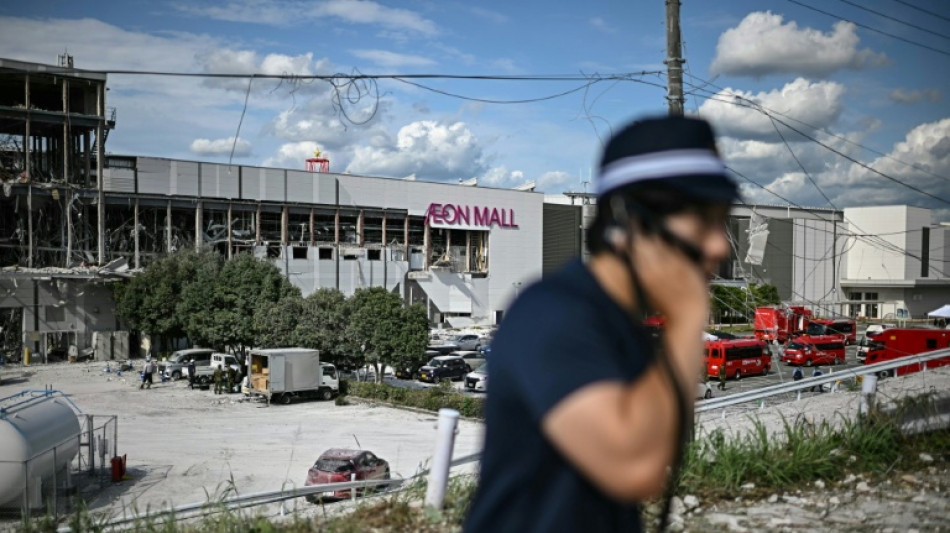
Sniffer dogs search mall wrecked after Japan quake / Photo: Philip FONG - AFP
Sniffer dogs in Japan helped rescuers Friday make a final sweep of a shopping mall wrecked by an explosion after a big earthquake, as the death toll from the tremor three days earlier hit 35.
"At the Aeon mall, 11 people were pulled out as of last night (Thursday), among them seven dead. To make sure that no one else is inside, we are finalising our confirmation with the assistance of professionally trained dogs," government spokesman Minoru Kihara said.
Local media quoted the operator of the mall, which was evacuated before being ripped apart by the suspected gas blast over an hour after Tuesday's quake, as saying that all employees were now accounted for.
At the other major disaster site following the 7.1-magnitude jolt, a paper factory, nine bodies have now been recovered and search and rescue operations were terminated, Kihara said.
Two survivors were also extracted from the site where a smokestack collapsed, he said, putting the overall death toll from the quake in the southwestern region of Kumamoto at 35.
The quake caused widespread damage, flattening homes, damaging bridges, triggering fires and leaving tens of thousands of residents without power and water in temperatures forecast to approach 40C (104F) this weekend.
As of Friday, around 4,500 households across Kumamoto still had no electricity and 79,000 households no water, Kihara said, with some 5,100 military personnel mobilised to help.
Thousands of people, many of them elderly, were escaping the heat in evacuation shelters.
One piece of good news was that 25 felines from a "cat cafe" inside the mall were rescued and transferred to Hiroshima, triggering widespread relief on social media.
Japan is one of the world's most seismically active countries, sitting on top of four major tectonic plates along the western edge of the Pacific "Ring of Fire".
Kumamoto itself was hit by two devastating earthquakes in 2016, which killed 273 people and injured more than 2,800.
The archipelago, home to around 125 million people, typically experiences hundreds of jolts every year and accounts for about 18 percent of the world's earthquakes.
The vast majority are mild, although the damage they cause varies according to their location and the depth below the Earth's surface at which they strike.
Japan is haunted by the memory of a massive 9.0-magnitude undersea quake in 2011, which triggered a tsunami that killed or left missing around 18,500 people and wrecked the Fukushima nuclear plant.
D.Findlay--EWJ